
By Neeraj Sinha, President, Renvio
"Dialysis is one of the few areas in healthcare where there is a real opportunity to prevent hospitalizations."
— Neeraj Sinha, President, Renvio
Prediction alone doesn’t prevent hospitalizations. Action does.
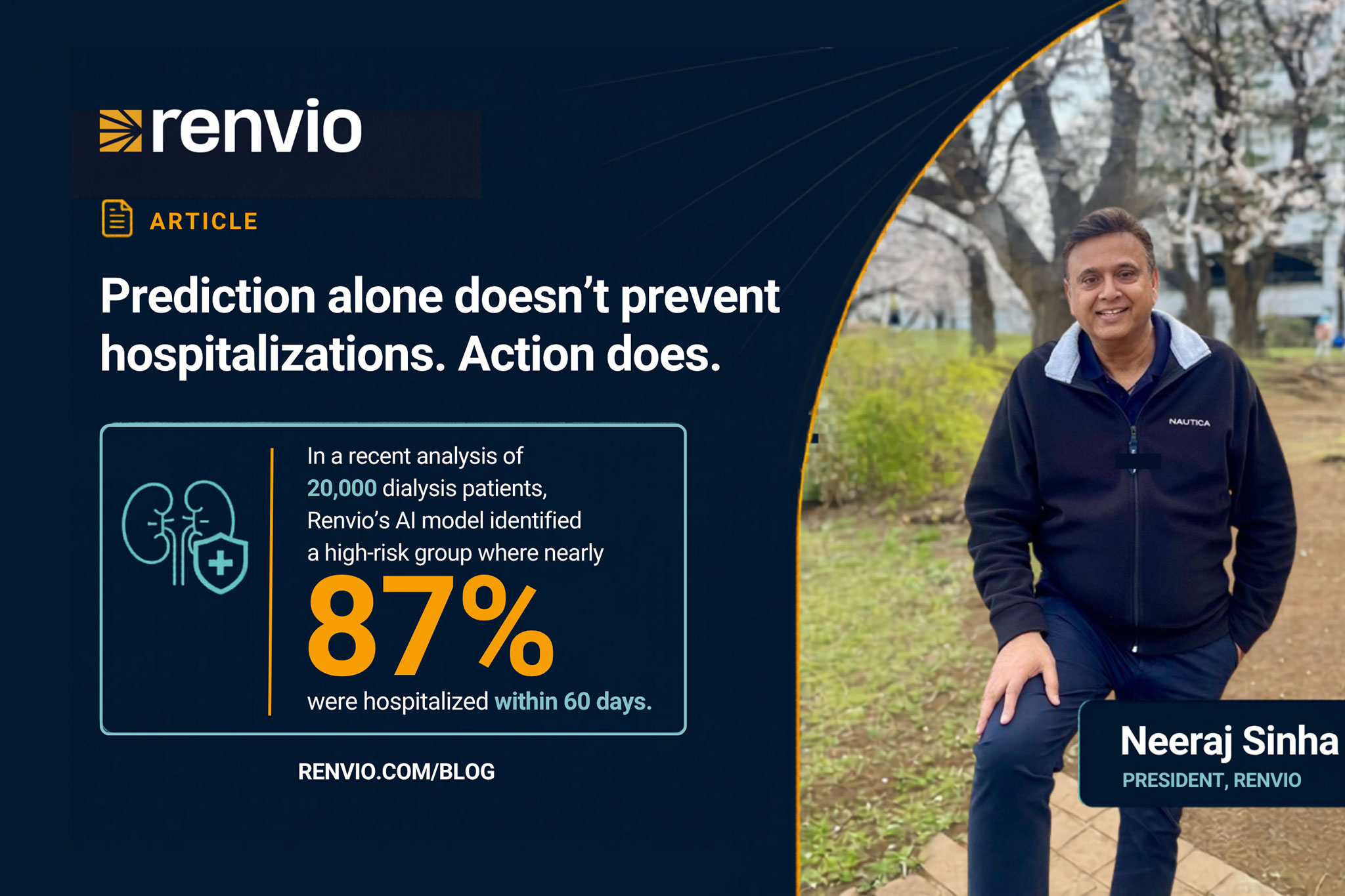
In a recent analysis of around 20,000 dialysis patients, Renvio’s AI model identified a high-risk group where nearly 87% were hospitalized within 60 days.
That is an impressive prediction.
However, we all know that prediction alone does not prevent a single hospitalization.
A risk score sitting in a separate dashboard does not change outcomes. What changes outcomes is when the care team sees the warning, understands why the patient is at risk, and has time to intervene.
Dialysis Clinics Have a Unique Opportunity to Intervene Early
Dialysis is one of the few areas in healthcare where there is a real opportunity to prevent hospitalizations.
Patients are seen two or three times every week. They generate a constant stream of clinical signals, including blood pressure trends, lab values, treatment adherence, ultrafiltration rates, access complications, and more.
The challenge is not a lack of data.
Hospitalizations rarely result from a single event. More often, they emerge from a combination of clinical, operational, and behavioral factors that build over time.
A missed treatment, a subtle laboratory trend, a recent hospitalization, or a gradual decline in treatment tolerance may not be alarming on its own. Together, those signals can point to elevated risk.
The challenge is getting the right signal to the right clinician at the right time. Longitudinal patient data makes this possible. Risk is rarely driven by a single laboratory value or treatment event. It emerges from patterns that develop over weeks and months, making historical context just as important as current observations.
"Even a 20% reduction in hospitalizations could mean 32 fewer hospitalizations, about 96 fewer missed treatments, and more than $24,000 in recovered treatment revenue each year. More importantly, it gives care teams more opportunities to keep patients stable, reduce avoidable disruptions, and confidently focus their time where it matters most."
— Neeraj Sinha, President, Renvio
Why Risk Scores Alone Fall Short
This is where many AI tools fall short.
They generate a score but place it in a separate portal or report. The clinician must remember to check it, interpret it, and then return to the EMR to act.
In a busy dialysis clinic, that is often one step too many.
AI becomes useful when it is embedded directly into the clinical workflow. The warning appears where the nurse or physician is already working.
Now, the clinician can immediately see both the risk and the factors contributing to it. Additionally, suggested actions are available immediately, but the decision of how to proceed remains in the hands the trained professionals using the software.
The prediction becomes part of patient care instead of another task on a checklist.
Turning Hospitalization Risk Into Clinical Action
The opportunity to intervene is significant.
Hospitalizations affect more than patient outcomes. They lead to missed treatments, additional care coordination, increased documentation burden, and lost treatment revenue.
For dialysis organizations, even modest reductions in hospitalization rates can have a meaningful impact on both clinical and operational performance.
Hospitalizations account for a large portion of ESRD healthcare costs, and approximately one in three dialysis patients are readmitted within 30 days of discharge.
For a typical dialysis center with 100 patients, the impact is felt every day.
At an average hospitalization rate of 1.6 admissions per patient per year, the center can expect roughly 160 hospitalizations annually. With an average stay resulting in about three missed dialysis treatments, that translates to nearly 480 missed treatments and more than $120,000 in lost treatment revenue each year.
Even a modest reduction in hospitalizations can improve patient outcomes while recovering significant revenue and improving quality metrics.
A 20% reduction in hospitalizations could result in 32 fewer hospitalizations, approximately 96 fewer missed treatments, and more than $24,000 in recovered treatment revenue annually, while also improving patient outcomes and reducing operational burden on clinical staff.
The Future of AI in Dialysis Is Workflow Integrations, Not Just Predictions
The future of AI in dialysis care is not simply a smarter prediction engine.
It is a smarter workflow where prediction, clinical context, recommended actions, and outcome tracking all live in the same place.
Because a prediction only has value when someone can easily investigate it, and act on it.
See How Renvio Helps Dialysis Teams Act Earlier
Renvio brings AI-enabled insights directly into the dialysis workflow, helping care teams identify patients who may be at risk for hospitalization, and giving them the context they need to take action.