
In your dialysis clinic, your team is always in motion.
During each shift, the care team is constantly moving from patient to patient. Orders need to be signed. Missed treatments need to be documented. Hospitalization updates need to be captured. Billing needs accurate and complete information before a claim can be processed. Clinic leaders need to understand whether documentation, treatment volume, staffing, and revenue cycle performance are moving in the right direction.
None of this work should happen in isolation from the other areas it impacts; namely, billing and performance visibility. We have to think about what comes next.
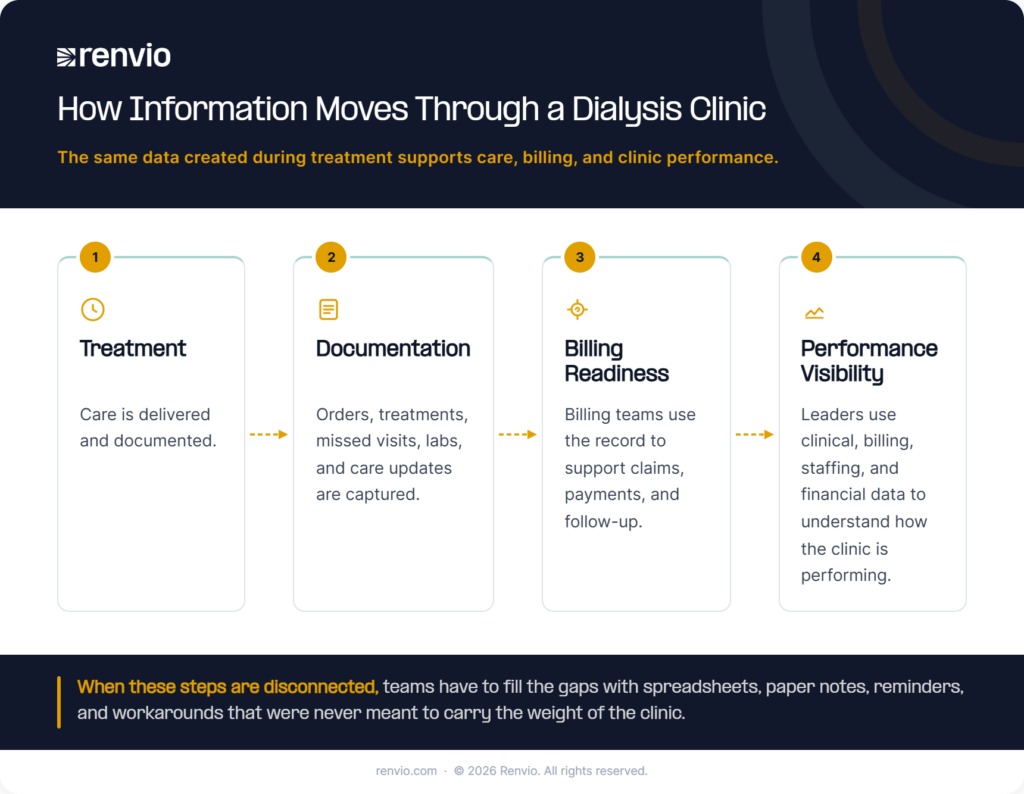
What happens during treatment needs to be captured in the medical record. What is captured in the medical record affects billing readiness. What happens in billing affects cash flow visibility. What leaders can see across the clinic depends on whether clinical, billing, staffing, and financial data can come together clearly enough to support informed decisions.
That is the real work of a well-connected dialysis clinic.
The Gap Between Capturing Data and Using It
Dialysis clinics do not operate like typical outpatient medical offices; it possesses a level of complexity that creates pressure at every point in the clinic.
In many organizations, each team develops its own way to manage the work. The care team documents treatment activity in one place. Billing follows up in another. Quality tracking may live in a spreadsheet. Staffing and labor data may sit in a separate system. Clinic performance may require several reports before leaders can see the full picture.
These workarounds are not usually a sign of poor management. They are often a practical solution to systems that were not built around the way dialysis clinics actually operate.
The problem is what happens over time.
A spreadsheet becomes the place where important details live. A notebook becomes the reminder system. A billing question becomes another call back to the clinic. A missed treatment trend may not be clear until after the month closes. A documentation gap may not surface until someone needs the record for billing, reporting, or survey preparation.
The clinic still runs, but the work takes more effort than it should.
A more connected clinic starts by looking at the path of the data itself: from treatment, to billing, to performance visibility.
This Is Why Renvio Exists
Most dialysis clinics already have the information they need.
The problem is that the information is often spread across too many places: the treatment record, billing workflows, spreadsheets, staffing systems, quality reports, and leadership dashboards. The data exists, but the connection between it all is harder than it should be.
Renvio’s Kidney Care Cloud was built to solve these problems.
The Kidney Care Cloud (KCC) connects the work happening across the clinic, from care documentation to billing readiness to performance visibility. Each part of the platform supports a different piece of the workflow, but the larger purpose is the same: make information easier to capture, easier to find, and easier to act on.
Here is how the key pieces of KCC, Dialysis Manager, Billing Manager, Renvio Clinic Insights work together:
Renvio connects dialysis documentation, billing, performance visibility, and AI-supported workflows across the Kidney Care Cloud.

1. Dialysis Manager: Where Treatment Data Begins
Most of the information that matters downstream starts during patient care.
Dialysis Manager supports the clinical workflow where teams document treatment activity, review patient history, manage orders, track labs, update care plans, and record important patient events such as missed treatments or hospitalizations.
The treatment record is not only a clinical document; through this system, it becomes the source for care continuity, billing readiness, quality tracking, and leadership visibility.
When documentation happens inside a dialysis-specific workflow, the care team has a clearer path for capturing the information that matters. Required fields, standardized processes, and connected patient history reduce the need to rely on memory, paper notes, or manual tracking. Now, you can reduce consistent sources of frustrations that take away from patient care, and rely on well-synchronized process to enhance both the efficiency of the daily treatment workflow.
Across Renvio customers, teams have reported treatment documentation error rates reduced by 20-30% because of required-field guardrails. Clinicians have also reported saving 5-10 minutes per patient per day on documentation and treatment workflows.
That time matters in a clinic where the team is already moving quickly.
Complete documentation does not only help the chart look cleaner. It helps the next person in the workflow trust what they are seeing.
2. Billing Manager: Where Documentation Becomes Billing Readiness
We all know that billing does not begin in the billing office. Instead, it begins with the information captured during care.
If a treatment was missed, if a field is incomplete, if a required detail is unclear, or if supporting documentation is hard to find, the billing team has to stop and follow up. That follow-up may be necessary, but it creates back-and-forth work between billing and the clinic.
The more missing information, the more time teams spend confirming what happened instead of moving the claim forward.
Billing Manager connects revenue cycle work to the information needed to support claims, payments, denials, and A/R follow-up. When billing teams can work from clearer documentation and better visibility into claim activity, they spend less time chasing details and more time resolving the work in front of them.
Across Renvio’s customers, billing teams have reported 10-15% less rework from fewer back-and-forth clarifications. Clinics have also reported a 20% improvement in clean-claim readiness.
That is the connection the article’s diagram is meant to show: billing depends on the record. When the treatment record is stronger, billing has a better starting point and quicker claim generation.
3. Renvio Clinic Insights: Where Data Becomes Performance Visibility
Clinic leaders need to answer questions that cross departments.
Are missed treatments increasing?
Are documentation gaps appearing in certain locations?
Which clinics are seeing higher A/R?
How are labor costs affecting cost per treatment?
Are changes isolated to one facility, or are they happening across the organization?
Those questions cannot always be answered from one system alone.
Renvio Clinic Insights brings clinical activity, billing performance, labor costs, and operational data into one view so leaders can see what is happening across the clinic or organization. Instead of assembling reports manually, leaders can review the patterns that matter and understand what may be driving them.
That visibility is especially important for independent and regional dialysis providers. Leaders often need to compare multiple clinics, payers, time periods, staffing patterns, and performance indicators without waiting hours or days for someone to assemble the data.
Across Renvio customers, leadership teams now receive the answers they need in minutes, instead of spending multiple hours or days to obtain answers to core operational and financial questions.
That is the difference between assembling the picture and acting on it.
4. AI Capabilities: Where Connected Data Helps Surface What Needs Attention
AI only matters if it helps the clinic do real work. In dialysis, that means surfacing information earlier, reducing unnecessary steps, and helping teams see patterns that may otherwise stay buried in the record or reports.
Renvio’s AI capabilities are not meant to replace clinical judgment. They are meant to support it by making patterns easier to see and workflow questions easier to answer.
That may include surfacing clinical trends, helping identify patients who may need closer attention, reducing time spent searching for information, or supporting task completion inside the workflow. In the connected clinic model, AI is not a separate lane. It works from the information already being created across the Kidney Care Cloud.
The goal is simple: help teams find what matters sooner.
Across Renvio customers, common workflow questions have been resolved instantly in 10-15% of cases, helping reduce ticket volume. Teams have also reported task completion time improved by 10-15 minutes per patient per treatment when AI support and automation are part of the workflow.
The point is not more alerts. The point is better visibility inside the work the team already does.
What a More Connected Dialysis Clinic Really Looks Like
A connected dialysis clinic does not remove the complexity of dialysis care. It makes that complexity easier to manage.
Treatment data can support the care team at the chairside. Documentation can support billing without as much back-and-forth.
Billing data can give leaders a clearer view of revenue cycle performance. Staffing and financial data can help show what is driving cost per treatment.
AI can help surface patterns that may need attention sooner.
This is the path from treatment to transparency.
For clinic teams, that means fewer disconnected steps. For billing teams, it means clearer information to support their work. For leaders, it means a better view of what is happening across the organization.
For patients, it means the team has more of the information it needs when it matters.
Taking the First Step Toward a More Connected Clinic
Most dialysis clinics already have the data they need. The problem is that the data often lives in too many places.
A more connected clinic starts by asking practical questions:
- Where does treatment information begin?
- Where does billing need to verify details?
- Where do leaders lose time assembling reports?
- Where are staff still using spreadsheets, paper notes, or manual reminders?
- Which questions take hours or days to answer today?
The answers to these questions can point to the gaps that matter most.
Renvio’s Kidney Care Cloud brings Dialysis Manager, Billing Manager, Renvio Clinic Insights, Billing Services, and AI capabilities together around the real work of dialysis care. The goal is not to add another system for teams to manage. The goal is to connect the work already happening across the clinic so information is easier to capture, easier to find, and easier to act on.
It is time to start taking steps toward a more connected dialysis clinic. Your patients will feel the difference. Your team will, too.